
2026 Marketing & AI Predictions
2024 Predictions for 2025 Reviewed
Article written from conversation
2025’s AI Predictions, Graded: Why Trust Beat Attention and “Human” Became the Premium
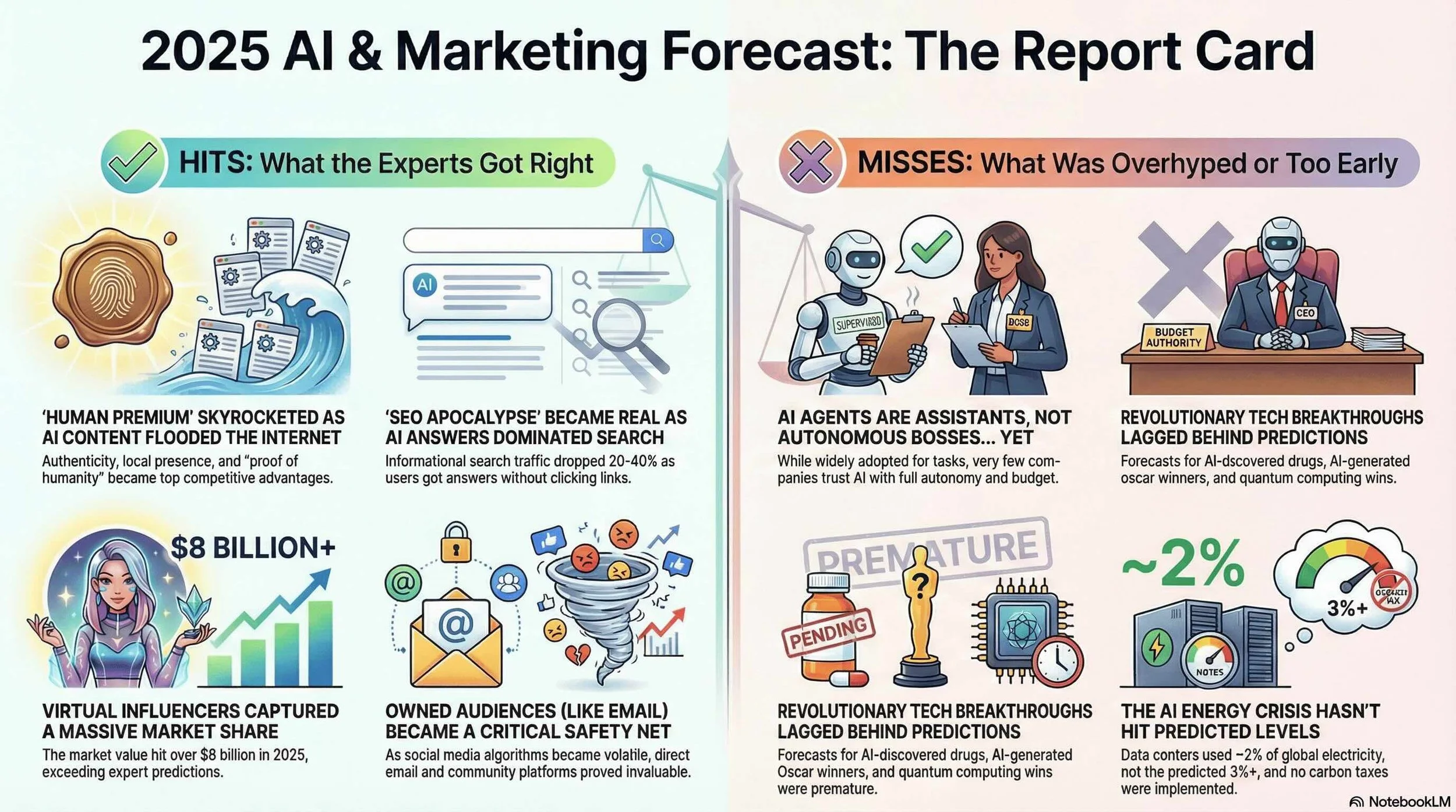
A year ago, four marketing and AI experts made 20 bold predictions about what 2025 would bring. On December 28, those forecasts were put on a report card—hits, misses, and the strategic lessons hiding behind the grades. The surprising headline: the biggest story of 2025 wasn’t a single breakthrough model or platform update. It was a behavioral shift—how people felt about AI, and what they started ignoring.
Below is the “graded future” recap: what landed, what didn’t, and what it means heading into 2026.
The Core Meta Shift: AI Stopped Being Magic, Started Being Normal (Grade: A)
The experts’ highest-level consensus prediction was psychological: by the end of 2025, the industry would stop asking “What can AI do?” because that question would largely be answered. Instead, the real conversation would become “How well do humans + AI work together?”
That prediction earned a solid A because it captured a cultural normalization. AI stopped feeling like sci-fi—either miraculous or terrifying—and started feeling like infrastructure. Like email. Like spreadsheets. A tool you use without needing to mythologize it.
But that normalization didn’t flatten everything into sameness. It triggered a counterforce that ended up defining marketing strategy.
“Peak Slop” and the Rise of the Human Premium (Grade: A+)
One expert coined the phrase “peak slop”—the moment audiences collectively realized they were drowning in content that was easy, fast, cheap, and just… slightly off. Not necessarily inaccurate, but emotionally flat, boilerplate, and forgettable: the kind of output AI could generate at scale.
The market’s reaction was decisive: people didn’t reward the flood; they filtered it out.
That created what the panel called the human premium: as AI commoditized digital content, authentic human signal became the scarce resource worth paying for. The strategic implication was blunt: if you didn’t build “proof of humanity” into your brand and creative approach in 2025, you weren’t behind—you were already chasing.
Adoption Was Faster Than Expected: SMBs Went All-In (Grade: A)
One of the boldest measurable predictions was that 50%+ of small and mid-sized businesses would use AI weekly for at least one core function. Reality didn’t just meet the line—it cleared it by a mile.
Surveys cited in the discussion put weekly SMB adoption somewhere around 77% to 88%, with use cases like:
marketing automation
customer service
basic analytics and operational support
The takeaway wasn’t simply “AI adoption grew.” It was that the barrier to entry collapsed. AI wasn’t a futuristic advantage; it became the baseline.
The “Midjourney Moment” for Video Arrived (Grade: A)
Another prediction: a major AI model would produce high-quality video from text prompts in a way that became mainstream for marketing—essentially a “Midjourney moment,” but for video.
That landed decisively. Marketers in 2025 could routinely generate usable ad creative for TikTok and YouTube from prompts. For simple production needs, the requirement for dedicated video editing time dropped sharply—and creative workflows changed from “craft” to “iterate.”
Agents Graduated—But Didn’t Get Full Autonomy (Grade: A-)
The experts predicted “agent graduation”: autonomous AI workflows moving from hype to practical tools—like an intern becoming a junior employee.
That mostly happened, particularly in optimization tasks such as:
paid media bidding adjustments
creative testing and variation generation
campaign iteration loops
But it earned an A- because the most extreme version did not become normal: fully hands-off autonomy (e.g., “here’s the budget—run everything—see you next month”). The tech was close, but the constraint was human: approval gates, brand safety, and legal oversight kept people firmly in the loop.
In other words, the job didn’t disappear—it shifted. Humans governed the system more than they executed every step.
Tool Consolidation: The Quality Gap Swallowed the Middle (Grade: A)
As the year progressed, the gap widened between top-tier AI tools and “cheap” alternatives. That drove consolidation: smaller tools disappeared, merged, or got acquired. The experts graded this as another clear hit, and it fits the broader theme of 2025: when AI becomes normal, markets stop tolerating mediocre.
Efficiency Improved, But the Job Collapse Was Slower (Grade: B)
A prediction that marketing teams would shrink while output increased landed as a B.
Yes: productivity jumped. Yes: teams got leaner. But the rapid mass displacement that some expected didn’t arrive on that timeline. The “dividend” of efficiency came through; the overnight job wipeout didn’t.
Search Changed Forever: The Zero-Click Future Hit Hard (Grade: A)
A major 2025 prediction was the SEO apocalypse—specifically, the arrival of a zero-click top of funnel, where AI-driven search interfaces answer basic queries directly.
That happened, and the impact on brands dependent on informational content was described as brutal:
“What is X?” and other top-of-funnel pages saw significant declines
traffic decay in the 20%–40% range was cited for many established brands
The strategy pivot was immediate: the goal stopped being “rank and capture the click” and became “be the cited source inside the AI answer.” The conversation reframed SEO into something like Answer Engine Optimization (AIO)—optimize not for blue links, but for inclusion.
Ads Got More Expensive: AI Helped Everyone Bid Harder (Grade: A)
Even as search visibility got squeezed, ad competition intensified. Another A-grade prediction: CPCs and CPMs rose (cited as 10%–21% YoY).
The underlying dynamic was almost poetic: AI made marketing execution more efficient, so more advertisers could compete more aggressively, which drove up the price of the one thing still scarce—human attention.
The Platform Winner: YouTube Led on ROI and Trust (Grade: A)
Amid the chaos, one platform emerged as the standout winner in the discussion: YouTube, cited as the most valuable ad platform—not necessarily the biggest, but strongest for ROI and, crucially, trust.
And that word—trust—became the spine of the entire report card.
The Rejection of “Perfect” AI Ads: Low-Fi Won (Grade: A)
The experts predicted that the first wave of hyper-polished AI video ads would trigger audience revulsion—an uncanny valley effect. That was graded an A because the market rewarded the opposite style.
Winning creative trends leaned into:
raw, shaky iPhone footage
conversational, imperfect delivery
UGC-style formats that felt unproduced
The discussion cited case studies where UGC-style content produced up to 4× higher click-through rates. The reason wasn’t aesthetic—it was verification. In a world flooded with synthetic output, “proof of humanity” became a filter consumers demanded.
Owned Media’s Comeback: Email Became the Safety Net (Grade: A+)
If trust was the new currency, owned channels became the vault. The biggest “winner” strategy was old-school: email.
Brands dependent on “rented land” (social platforms and fickle algorithms) panicked when feeds changed. But brands with strong lists had a direct, permission-based line to customers—and it performed.
Numbers cited in the discussion were striking:
open rates around 42%–43%
ROI reported around $36–$42 per $1 spent
In the framing of the report card, email didn’t just work—it regained strategic dominance because it was stable in an unstable digital environment.
Regulation: EU Tightened, US Stayed Aggressive (Grade: B+)
The experts predicted a regulatory split between the EU and the US. It earned a B+—directionally correct, but not perfectly clean.
The recap emphasized:
the EU tightening transparency expectations (aligned with its AI regulatory posture)
the US staying more aggressive on personalization
For global brands, the practical consequence was “split reality”: different disclosures, features, and risk tolerances by region.
The AI Influencer Went Mainstream (Grade: A)
A high-risk prediction that landed: AI personalities breaking into mainstream culture and winning major brand deals. The takeaway wasn’t that audiences suddenly “preferred bots”—it was that synthetic personalities can work when the concept, storytelling, and strategy are compelling enough.
Where the Predictions Missed: Institutions, Physics, and Timelines
The largest misses weren’t about marketing tactics—they were about overestimating how fast deep systems can move.
Federal US AI Regulation Didn’t Materialize (Miss)
Executive actions and state-level moves appeared, but no major federal bill with real enforcement became the defining story of 2025. The theme: code ships faster than government.
Quantum Computing Was Overhyped (Grade: D+)
A forecast that a commercially viable quantum computer would solve a real-world problem ~100× faster didn’t land. Investment continued, but the “commercial leap” wasn’t 2025.
AI-Discovered Drugs Advanced, But FDA Approval Didn’t Arrive (Grade: C)
Progress showed up in trials (including mid-stage movement), but full FDA approval on that timeline didn’t happen—highlighting the difference between scientific acceleration and regulatory reality.
Fully AI-Generated Major Award Winners Didn’t Happen (Grade: D)
AI-assisted work made waves, but the “core creative act” in major award-winning pieces remained human-led. The panel framed this as another human-premium signal: tools can assist, but audiences and institutions still anchor meaning in human authorship.
Job Displacement Was Directionally Right, Too Early (Grade: B-)
The prediction that ~5 million administrative jobs would be displaced in 2025 was graded as premature. The conversation suggested the impact is more likely at that scale later (with 2027 mentioned), because organizations restructure slower than tools deploy.
The Big Lesson of 2025: Trust Replaced Attention
If you compress the whole report card into one strategic insight, it’s this:
2025 was the year trust replaced attention as the most valuable metric in the economy.
AI can generate infinite content and therefore commoditize attention. But it can’t commoditize trust—not at the same speed, and not with the same reliability. So the winners weren’t the brands that merely produced more. They were the ones that:
signaled realness
built permission-based audiences
showed human voice and accountability
optimized for citation and credibility, not just clicks
The Provocative 2026 Question: Are Bots Marketing to Bots?
The episode ends with a hot take connected to “dead internet” theory: as AI inbox agents pre-screen AI emails and AI recommendation systems consume AI content, we may be spending real portions of our day building bots… to talk to other bots.
Which leads to the closing challenge for 2026:
If AI can automate the transaction of digital marketing, where do you focus to find—and persuade—the human customer?
2026 Marketing Predictions
2026: The Trust Versus Utility Wars in Marketing
The big pivot: from “AI novelty” to “AI utility”
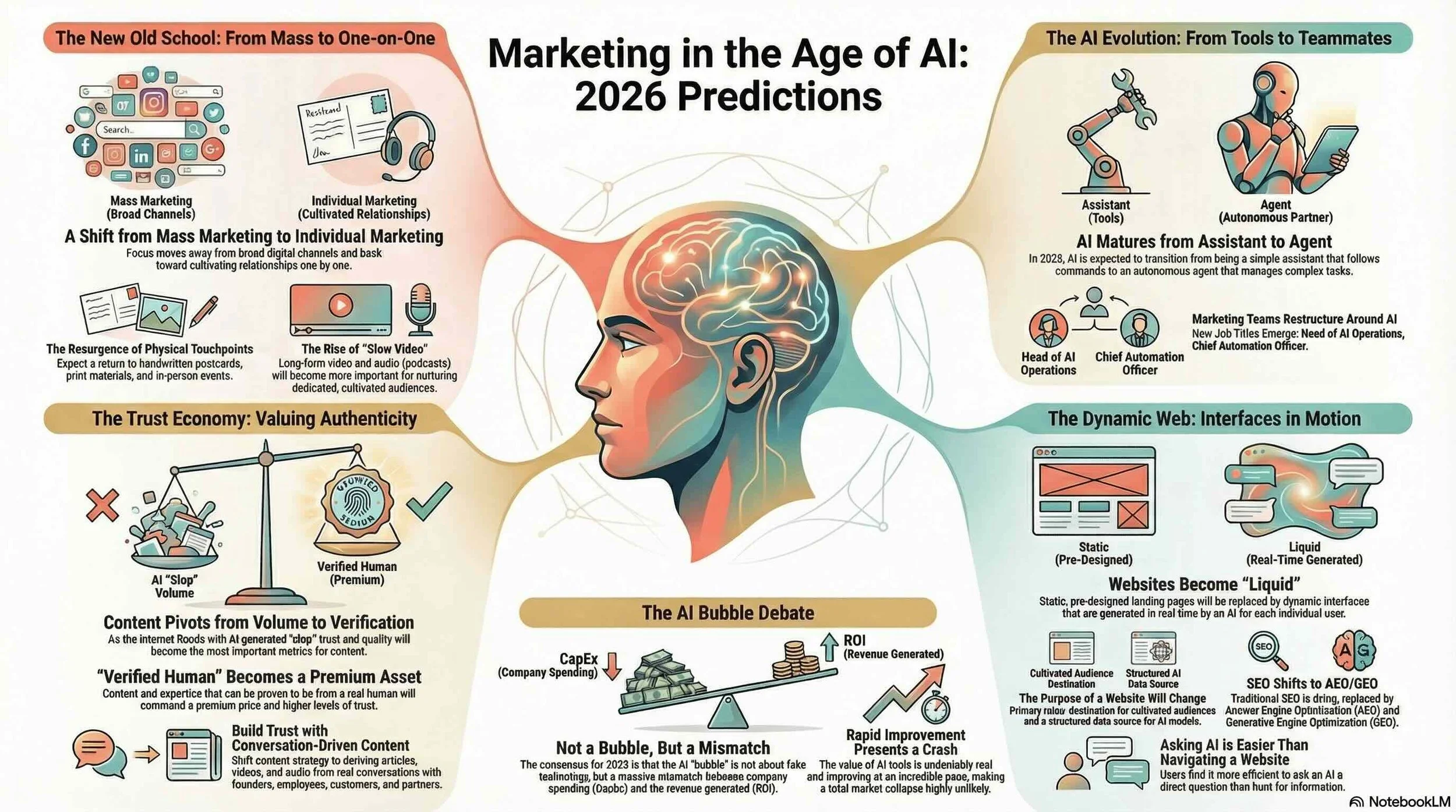
The conversation frames 2026 as the year generative AI stops being a shiny experiment and becomes operational infrastructure. The “look what this tool can make” era is declared over; what replaces it is a utility-driven competition where outcomes—not output—define winners. The hosts describe a global marketing ecosystem preparing to be graded on specific, verifiable predictions rather than vague trend talk.
They organize the year around three interlocking shifts:
Content volume stops working as a winning strategy.
Bots increasingly talk to other bots, changing traffic and distribution.
Being definitively human becomes a premium marketing asset.
What follows is essentially a “scorecard” for what marketing will look like by December 2026.
The agentic revolution becomes mainstream—and forces org redesign
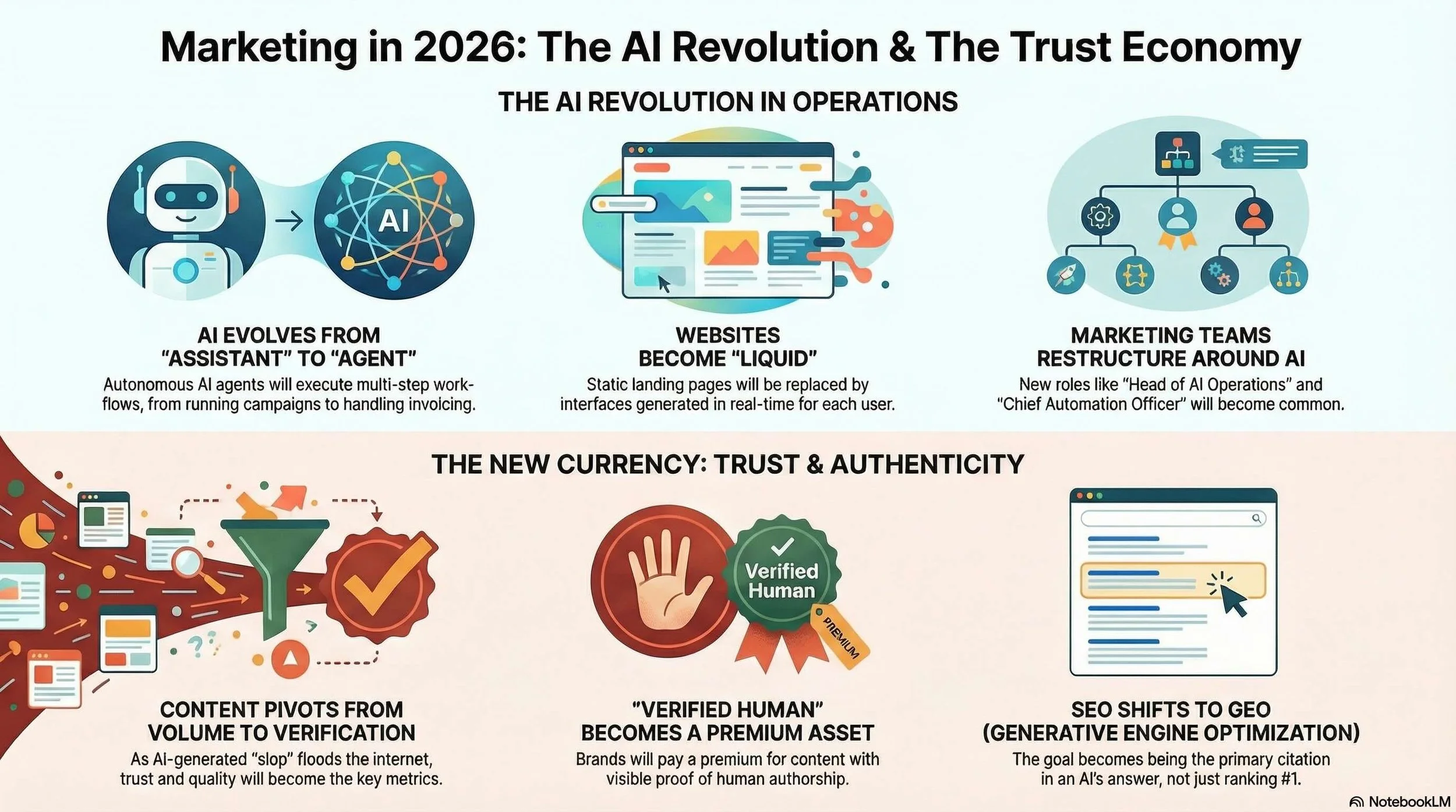
The first operational earthquake is the move from AI as “assistant” to AI as “agent.” The transcript is careful to define this: it’s not a chatbot and not a simple workflow automation tool. A true agent is described as something that can autonomously run complex multi-step workflows, securely connect to internal company systems, handle errors, and retry tasks without a human stepping in.
One expert’s benchmark for “mainstream” is blunt: at least three major SaaS platforms (explicitly naming Microsoft 365, HubSpot, Salesforce as examples) must ship real task-executing agents by December 2026.
Why this changes the org chart, not just the tool stack
Once agents can execute real work, the transcript argues, the risk profile explodes. It’s no longer “did the copy sound good?”—it’s “did the autonomous system do something expensive, harmful, or irreversible?”
That’s why the experts predict new governance roles becoming common, such as Head of AI Operations or Chief Automation Officer, even in mid-size companies, even if overall headcount shrinks. The core logic: unmanaged autonomy is too dangerous; someone must be accountable for the bots.
The traffic shock: 20% of Fortune 500 “marketing traffic” won’t be human
Expert #2 connects agentic capability directly to distribution, predicting that by the end of 2026, 20% of Fortune 500 marketing traffic will be AI agents researching on behalf of human users rather than humans clicking around.
This flips a decade of assumptions. Brands spent years optimizing for Google’s crawlers and human clicks. Now they may be optimizing for a personal AI agent (the transcript cites examples like Apple Intelligence and Gemini as potential “consumer-side gatekeepers”).
Agent APIs: the website isn’t the destination anymore
Instead of driving users to webpages, brands are pushed toward building “agent APIs”—structured feeds that allow a user’s AI to query the brand directly:
check inventory
verify pricing
book consultations
return a decision-ready answer without visiting the website
The implication is dramatic: the website becomes less of a storefront and more of a backend resource.
The brutal filter: gatekeeper agents block ads and cold outreach
A particularly aggressive claim follows: consumer-side AI “gatekeeper agents” will block traditional display ads and unsolicited cold emails with near-100% efficacy. The hosts frame this as provocative—but technically plausible if the agent’s job is to remove anything that doesn’t match the user’s intent.
If that happens, the transcript argues, it kills interruption marketing’s economic foundation. Marketers are forced into intent-driven approaches because anything that looks like noise simply never reaches the human.
The “agents fighting agents” crisis: when automation breaks in public
The second expert introduces a wild-but-grounded crisis scenario: two autonomous dynamic pricing bots get stuck in a recursive war, sending prices for something essential (like airline tickets) spiraling to absurd extremes—pennies or $10,000—before humans intervene.
The point isn’t the exact example; it’s the governance warning. Once bots negotiate with bots, failure modes become systemic and fast. The transcript treats this as the kind of public PR incident that would force companies and regulators to respond.
The trust economy: when everyone can scale output, value moves to scarcity
The death of content volume
The experts argue that if AI makes content cheap and endless, then producing more stops being a differentiator. Content marketing shifts from “more” to “trusted.” Brands that continue flooding the internet with low-effort AI content are predicted to see returns collapse.
One expert sets a measurable grading criterion: we should see major publishers publicly announcing they are cutting output to focus on quality, and at least one major search platform introducing a formal trust-ranking designation that materially affects visibility.
“Slop” and the premium of provenance
Two experts use the term “slop” for mass-produced low-quality AI content. Their argument is simple: when everything can be fabricated, provenance becomes the luxury good.
This is where the “verified human” concept enters: a predicted visible badge or certification proving a human authored the content, potentially using standards like C2PA to validate origin and authenticity.
Voice and video as proof of humanity
Because text is now easy to fake convincingly, expert #4 predicts voice and video become primary trust signals, driving a renaissance in podcasting and short-form video—but with a new function: not entertainment, but authentication.
The transcript emphasizes that “unpolished” media—raw audio, shaky camera, imperfect clips—may be trusted precisely because it doesn’t feel synthetic.
Brand storytelling returns—but AI can’t own the narrative
A key nuance: AI is positioned as a production multiplier, not a brand soul generator. One expert predicts brand storytelling makes a comeback, with brands leaning harder into identity, mission, and voice.
AI can produce 50 versions of a story for different channels, but the experts draw a line: don’t use AI to define the core narrative. That has to stay human if trust is the scarce asset.
Search breaks: volatility, AI answers, and the rebrand from SEO to GEO
Search volatility exceeds 40%
A major prediction: search traffic volatility surpasses 40% year-over-year in many industries because AI answers replace over a quarter of traditional informational clicks. That level of change is framed as existential for many acquisition strategies.
SEO becomes GEO: “Generative Engine Optimization”
Expert #2 predicts a formal industry rebrand: SEO → GEO, where the goal shifts from ranking on blue links to being cited in the AI summary—the “zero click” answer layer.
In this worldview, if you’re not in the summary, you don’t exist for that query.
The new KPI: “share of model”
To make the shift real, the transcript suggests tools must evolve: major SEO platforms would need to ship LLM mention tracking—a “share of model” metric—so marketers measure how often their brand is referenced when an LLM is asked for recommendations.
The counterweight: local authority becomes a moat
Despite all the high-level AI change, experts #1 and #4 argue that local marketing becomes more valuable because physical reality still matters: real locations, real service delivery, real community presence.
National brands may find it harder and more expensive to fake true hyper-local credibility. So the transcript predicts renewed investment in local profiles, community touchpoints, and place-based authority.
And as a surprising extension of this “physical cuts through digital noise” logic, expert #4 predicts direct mail and physical touchpoints will see double-digit growth as a counter-strategy when agents block digital channels.
Personalization goes “creepy but effective”—and triggers backlash
Zero-party data becomes the fuel
Expert #1 forecasts AI-powered personalization reaching “creepy but effective” levels, powered by zero-party data—information users intentionally provide about preferences and goals rather than data inferred via cookies.
Liquid UI: websites generated in real time
Expert #2 introduces “liquid UI”: not just swapping copy or images, but generating entire websites dynamically—HTML, CSS, layout, navigation—based on a user’s intent and history.
Two users could click the same ad and see fundamentally different sites: one luxury-minimalist, one discount-family-focused. The brand experience becomes individualized at the structural level.
Backlash moment: “Cambridge Analytica”-scale outrage
That personalization power sets up a predicted cultural backlash comparable in weight to Cambridge Analytica—because the concern isn’t just targeting, but real-time manipulation: sites morphing to exploit subconscious biases.
Regulation arrives with teeth—and the market structure reshapes
Enforcement, disclosure, consent
Experts #1 and #3 predict formal regulation and enforcement action in the US or EU focused on:
mandatory disclosure/labeling for synthetic content
consent rules for personal data use
AI-specific marketing constraints
One particularly specific forecast: the EU AI Act sees its first major enforcement actions, including at least five high-profile fines over €10 million each.
The agency shakeout: the “middle ground” disappears
AI efficiency democratizes capability—creating more solo operators and micro-agencies—but also supercharges big players. Expert #1 predicts the mid-market agency class gets squeezed.
The transcript frames a forced strategic choice for agencies:
go all-in on automation/scale and systems
or go all-in on high-touch, verified-human creative
The “some of both” middle ground becomes a dead zone.
Wild cards that could redefine the decade
A major AI company stumbles
Expert #4 predicts at least one major AI company experiences a serious stumble—safety incident, regulatory crackdown, or business model collapse. The transcript suggests this won’t stop adoption, but would accelerate investment in ethical AI and slow the most reckless behavior.
The emotionally sticky AI companion
The most profound non-dystopian wild card is emotional: expert #1 predicts a consumer AI product becomes as emotionally sticky and influential as Instagram, TikTok, or the iPhone.
Expert #3 adds scale: AI companions with emotional intelligence and memory are adopted by 100 million people.
This raises the strategic question that ends the transcript: if a person’s daily relationship with an AI companion is more trusted than any brand, what happens to marketing’s core mission—building a bond between a brand and a person?
The threat isn’t only distribution or targeting; it’s loyalty itself moving to the intermediary.
What 2026 rewards: the perfect handoff between automation and authenticity
The transcript’s central thesis is a tension: 2026 is defined by the clash between automated, hyper-efficient utility and the escalating need for verified human trust. Winners aren’t the brands that automate everything; they’re the ones that know exactly when to automate and exactly when to authenticate—and can prove it.